

Boreal Kintaro Review
August 1, 2012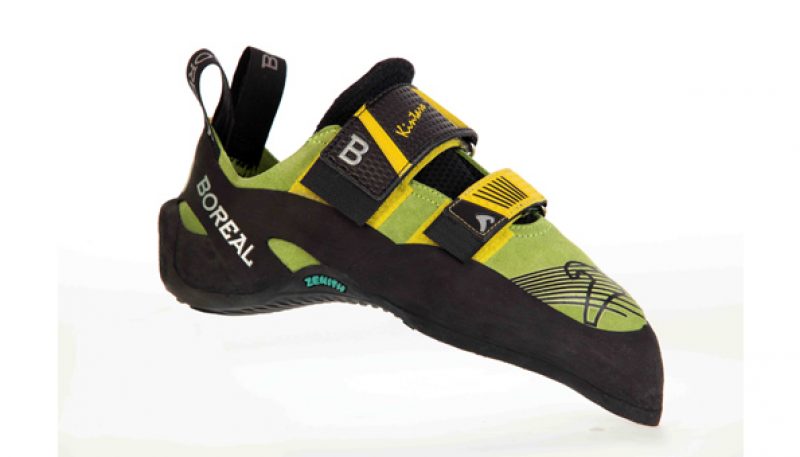 88
88 The Good
- Vari-sized Velcro closure—upper strap is extra-wide to let you ratchet fit without upper-foot cramping
- Great grabbing action on steeps
- Slim, snug, comfortable heel cup
- Very sticky rubber
- Bomber Spanish construction
The Bad
- 5-5.5mm sole thick out of the box, causing “smedging” where you want edging
- Stickier rubber tends to wear more quickly
- Slightly narrow fit (pointy toebox) for high-volume feet
A beautifully crafted steep-rock machine, for sport climbing and bouldering, with an aggressive downturn and savvy heel cup: slim so it fits snugly, but also comfortable and supportive thanks to the V2 Rand, which ties into an almost hoof-like protrusion for the calcaneus. Extra width on the upper Velco strap is a great advent, with no pinching or awkward pressure points along the tongue and uppers. And the new Zenith rubber is very sticky.
The Kintaro is the sort of shoe that makes you want to pack up and move to Spain, where the 3-D limestone cave climbing demands an aggressively downturned shoe that grabs like a lemur’s tail but also stays on capably for scumming, heel hooking, and foot cams. Sure, America has its Madness Caves and Arsenals, but the footwork on those flatter surfaces tends to be less, well, European.
Grab Monster
The main attraction with a slip-lasted, downturned shoe is “grabbing” ability—digging your big toe into a foothold and tractioning, to align with the rock on extreme overhangs. That is the beauty of such shoes, which does, however, make them a specialist’s boot: try them on a slab or crack climb and you’ll scream for mama.
The Kintaro has an elegant downward curve and a pointy toebox that focus power into the forefoot: They’re grabbing machines, with reliable precision and heightened sensitivity in the red zone. With a low-volume foot, you should be able to maximize this fit, getting all the way down and into the point. The stickiness of the rubber helps as well—the Kintaros excel at their métier.
Velcro closure
One downfall of Velcro shoes is the pressure that the strap exerts across your foot top when it is too thin and you cinch down for a performance fit. I’ve even noticed this with triple-closure shoes—an annoying tendency to cause pressure and cramping. Boreal solved this problem by vari-sizing the Kintaro’s two straps. The upper one, which overlays a comfortable mesh tongue, is extra wide to ameliorate pressure points on the foot’s meatiest area, complemented nicely by the medium-sized lower strap. Boreals don’t stretch much, so the bulk of your fit-control lies in the two straps.
Stick-um
Boreal’s new Zenith rubber (also on their face boot, the Lynx) is a soft, grippy formula well-suited to the grabbing and smearing of the über-steeps—the rubber practically molds into the rock’s features. That said, the soles come thick (5 to 5.5mm) so they tend to roll/compress while edging, giving them more of a “smedging” (smear-edging) feel until you wear the rubber down. Softer rubbers do wear more quickly, so perhaps this width represents a compromise between performance and durability.
Heel power
Heels are tough. Make them too thin and fatter-footed people like myself can’t get into the shoe, but make them too wide and they bag like an old athletic sock. The V2 Rand system on the Kintaro straddled the middle ground perfectly. The heel profile is slim, great for slotting into tight, aggressive hooks; however, thanks to the heel cup protruding slightly backward, people with high-volume feet can still slip their dogs in without exploding through the toebox. There was just enough pull from the double-tined V2 Rand to keep the Kintaros on while hooking but without discomfiting your Achilles tendon. They have a solid crescent of rand rubber up front as well, for toe hooking and scumming.
The Kintaros are extremely well built—a lime-green and yellow Spanish treasure to behold—and should stand up to multiple resoles. They also come in a women’s version.

No reviews have been posted for this product.